Solid Roguelike Game, Average Deck Builder
Looper Tactics Demo Review
By lyndonguitar
Published on June 23, 2023 Review
 PlayTested
Scan to read
full review
full review
PlayTested Ask this review
AI answers drawn only from this article
1 / 7Looper Tactics
Looper Tactics is a turn-based strategy card game infused with roguelike elements, and presents players with a journey through a procedurally generated world of eternal life and death.
Procedurally generated world
Engaging deck building and strategic card gameplay
Roguelike but with emphasis on continuity and persistent progression## Cons
-Lack of unique or special mechanics
-Noticeably lacking quality-of-life features
-Some story elements feel gimmicky
Looper Tactics aims to combine turn-based strategy and roguelike mechanics, providing an interesting twist on traditional deck building. Visually, Looper Tactics adopts a minimalist art style with a focus on simplicity. The game’s aesthetics, while not groundbreaking, effectively convey the atmosphere of an otherworldly realm as well as a tabletop RPG setting. The tile-based maps are visually distinct, with each tile clearly represented. Although the game’s graphics are not visually stunning, they serve their purpose by providing clarity and facilitating gameplay understanding.
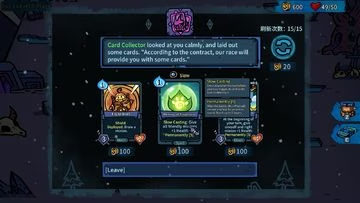
The core gameplay revolves around navigating a tile-based map, strategically moving your hero across various terrains and encountering both friend and foe. The worlds are separated into different class levels B, A, S, and SS. And must all be completed to face the final boss. The procedurally generated world every run ensures that each playthrough feels fresh and unpredictable. Throughout the game, you will have encounters with various friendly or neutral beings, many of whom offer you a choice between different bonuses and items to purchase, such as new cards, minions, power-ups, or upgrades.
Encounters with enemies initiate turn-based strategic card battles. The combat system is straightforward. Player cards will attack the enemy card in front of them on the table, taking into account their offensive and defensive stats. If there is no opposing card present, such as when the spot is empty or the opposing card has been defeated, attacks will directly target the opposing hero unit.
At the end of each turn, both heroes inevitably attack each other. The complexity and game-changing factors on the other hand comes from the properties of the individual cards, which determine how the cards respond and impact the battle. For instance, some cards have additional attacks against adjacent cards, while others provide additional health points to neighboring cards. There are even cards with a “revenge” trait, which means that upon dying, they deal a final blow to hostile cards. The ultimate objective is to deplete the health points of the enemy heroes.
The persistent health points across battles and the ability to carry over enhancements between cycles add an additional layer of depth and continuity to the gameplay. Each defeat becomes a learning experience, pushing players to refine their strategies and optimize their deck compositions.
As part of the roguelike experience, Looper Tactics ensures that each playthrough is unique, with the procedurally generated world offering fresh challenges and surprises. As players progress through the game, they unlock new cards, minions, and power-ups, allowing for greater customization and strategic depth in subsequent playthroughs. This sense of progression and growth incentivizes multiple replays, as players strive to build more powerful and versatile decks.
The story revolves around the concept of being trapped in an eternal cycle of death and resurrection, seeking freedom from the confines of this illusory trap. Looper Tactics attempts to incorporate a self-aware and unconventional narrative, aiming to challenge players’ perceptions and expectations. While the premise is intriguing, the execution falls short. Although the game attempts to introduce twists and mind-bending sequences such as visual glitches and programming code references, they feel gimmicky and come across as forced and pretentious.
While the game is engaging and fun to play like many other decent deck-building games out there, it is missing some quality-of-life features. One such feature is the ability to cancel actions. Once you place a card on the table, you are unable to retrieve it, even if the move has not yet been finalized. This limitation also applies to skills in the game.
Conclusion:
Looper Tactics presents an engaging fusion of turn-based strategy and card game mechanics, accompanied by a procedurally generated world that offers replayability. The gameplay mechanics are solid, providing enjoyable tactical battles and strategic exploration. However, the game lacks a sense of uniqueness or exceptionalism and also falls short in terms of visual variety and incorporating forced self-aware elements. For those interested in the game, Looper Tactics is coming soon, with a Demo already available for players to try.
Original link
Originally posted on TapTap.
PlayTested 
Final Fantasy XVI delivers a dark, complex story far removed from nostalgia, with strong cinematic action, a dynamic combat system that grows over time, and impressive medieval-themed visuals.

In a world full of disappointing sequels, reboots, and spiritual successors. We have one of the rarest examples of a franchise that has gotten better in time in HITMAN World of Assassination.
Death Stranding 2 refines the unique, contemplative gameplay of its predecessor with polished mechanics, an epic story, and a bold, niche approach that challenges mainstream gaming norms.
PlayTested AI
Answers from our reviews
Comments